
An Open Letter to STEM Teachers

 By Nader Fadaee on
Why students who know the content still lose marks in exams.
An open letter to STEM teachers
Dear STEM teachers, and chemistry teachers in particular,
I want to begin with what I value. You stand at the front of a room, several times a day, and attempt something that the rest of us rarely have to attempt: to take an idea that lives clearly in your own mind and place it, intact, inside thirty other minds that arrived that morning with thirty different histories. I’ve taught for long enough to know how difficult that is, and how little of the difficulty is visible from outside the room.
So this letter isn’t a complaint. It’s an observation about a gap that I think we share, and that I don’t believe either of us can close alone.
The gap is between understanding and teaching. A teacher who understands ionic bonding deeply doesn’t automatically transmit that depth; the understanding has to be reconstructed, from scratch, by each student in turn. Richard Feynman used to recall his father teaching him the difference between knowing the name of a bird in several languages and knowing anything at all about the bird. Much of what passes for learning in a science classroom is the first kind of knowing. The student can name the process, label the diagram and recite the definition, and yet the thing itself hasn’t arrived. The lightbulb, the moment where the subject stops being a set of instructions and becomes a way of seeing, hasn’t switched on.
Many students leave a brilliant classroom without that moment. I want to be careful here, because the temptation is to locate the failure somewhere, and the student is the easiest place to put it. I don’t think it belongs there. A student who hasn’t yet understood is not a student who has failed to understand. They’re a student for whom the right explanation, in the right order, at the right pace, hasn’t yet been found, and the search for it is our responsibility, not theirs.
That’s the imperative I want to put to you, and to myself. When a method doesn’t produce the spark, the honest response is to seek out a different one: a new system, a different resource, another route into the same idea. The mentoring work we do at Better Life Tuition exists in the space after your lesson, not instead of it. Our job is to find the second explanation, and the third, until one of them lands, and then to help the student enjoy the process enough to keep going once it has.
I don’t have a complete answer to the gap between understanding and teaching. I’m not sure anyone does. But I’m certain that it narrows fastest when the people on both sides of it stop treating it as the student’s problem and start treating it as ours.
With respect and gratitude,
Nader
Founder, Better Life Tuition
This month’s action item
If you’re a student: the next time a topic doesn’t make sense in class, don’t conclude that you can’t do it. Write down, in one sentence, exactly where the explanation stopped making sense. That sentence is the most useful thing you can bring to a teacher or a mentor, and it’s where the search for a better explanation begins.
The Interpretation Gap Framework
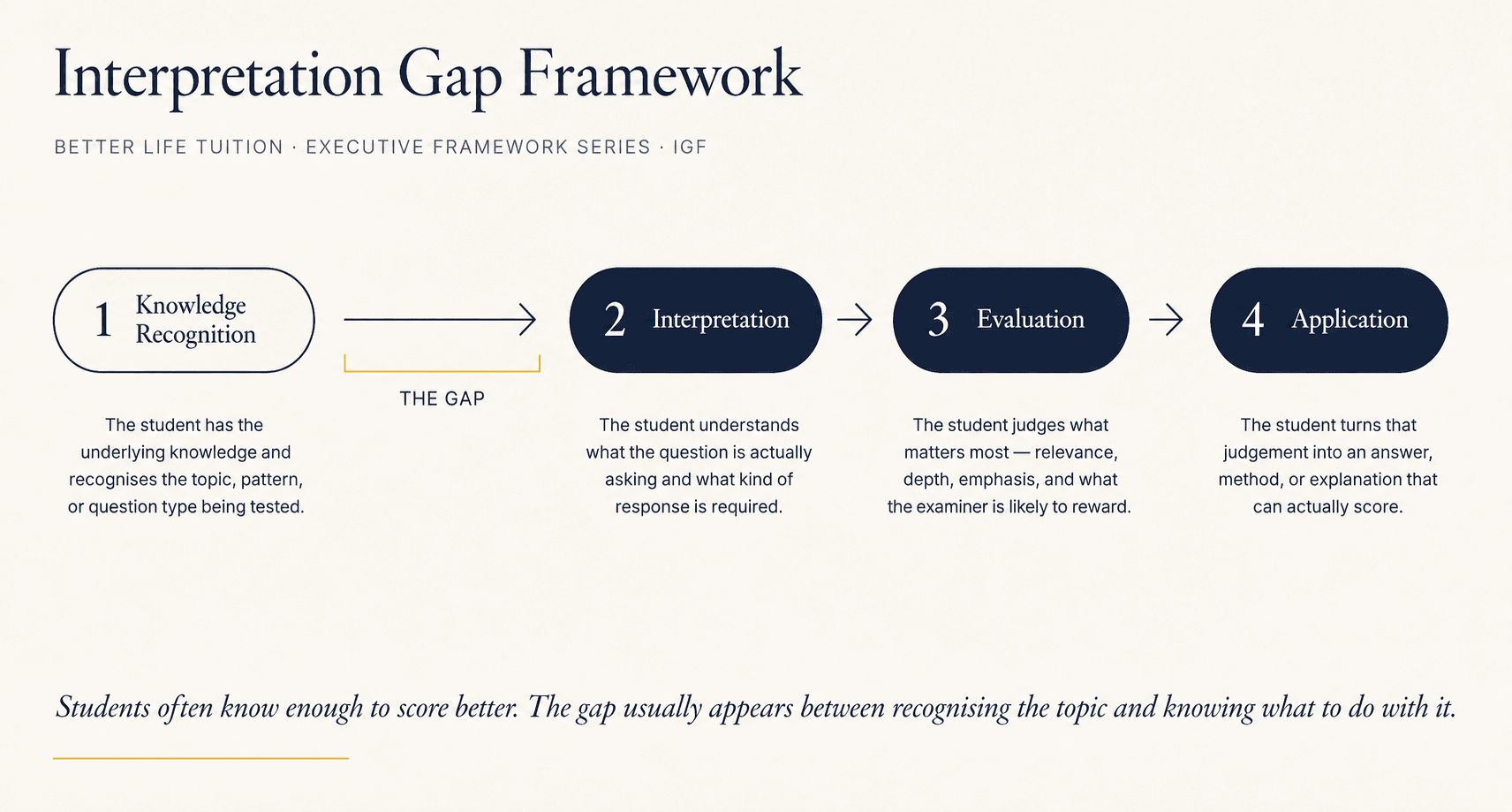
Students often know more than their answers suggest. The missing link isn’t effort alone. It’s judgement.
There’s a familiar disappointment in September. A student worked hard through the summer, recognises every topic on the paper, and still scores below what their knowledge should have earned. The instinct is to diagnose a gap in knowledge and send them back to the notes. In our experience, that diagnosis is usually wrong.
The Interpretation Gap Framework describes four stages between knowing something and scoring for it. Knowledge recognition comes first: the student sees the question and knows which topic it belongs to. Interpretation follows: they work out what the question is actually asking, which is often narrower and more specific than the topic it sits in. Evaluation is the stage most students skip: deciding what matters most in this answer, what can be left out, and what the examiner is likely to reward. Application is the writing itself, where judgement becomes marks.
The gap usually opens between the first and second stages. A chemistry student recognises a moles question and begins calculating, without noticing that the question is really about which reagent runs out first. A physics student sees “explain” and describes. The knowledge was there. It was the reading of the demand that failed, and no amount of re-reading the chapter repairs that.
It’s a little like being handed a map of a city you know well and being asked for directions. Recognising the streets isn’t the same as knowing which route the person in front of you actually needs.
For students
Before you write anything, spend thirty seconds on two questions. First: what is this question asking me to do, in my own words? Second: what will the examiner give marks for, and what will they ignore? If you can’t answer the second, you’re about to write an answer that feels complete and scores partially. This month, try it on one past-paper question a day, and compare your answer against the mark scheme for what you included that earned nothing.
This month’s action item
Take one past-paper question you got wrong this summer. Before looking at the answer, write down what you now think it was really asking. Then check the mark scheme. The difference between the two is your interpretation gap, made visible.
For parents
When a student says “I knew it, I just didn’t get the marks,” they’re usually telling the truth, and it’s worth believing them. The most useful response isn’t “revise it again” but a question that points at judgement rather than knowledge: “What did the question want that your answer didn’t give it?” That question is harder to answer and far more productive, because it directs attention to the stage where marks are actually being lost.
If you’d like to help without adding pressure, sit with one marked paper together and look only at the questions where your child clearly knew the topic and still dropped marks. Those questions, not the ones they found difficult, are where the fastest improvement lives.
This month’s action item
Identify one question type where you consistently know the topic and consistently lose marks. Bring that question type, not the whole subject, to your next lesson or session.
So the question this month isn’t whether your child knows enough. It’s whether they yet know what to do with it. What would change if the next hour of revision went into judgement rather than recall?
Three results worth understanding
Results season has passed and we’d like to mark three outcomes from students who have worked with us. They remain unnamed here, which is how it should be until each has chosen otherwise, but each result illustrates something about method that’s worth setting down.
One of our A-level students has been with Better Life Tuition since Year 7. This summer they achieved four A* grades, in Maths, Further Maths, Physics and Chemistry, and will read at Harvard this autumn. The grades are the visible part. The less visible part is six years of steady, deliberately allocated work, through which a student who arrived as a capable eleven-year-old built the judgement to sit four of the most demanding papers available and treat each one as a question of what mattered most. That’s not a story about talent alone. It’s a story about how consistency, given enough time, becomes something close to certainty.
The second result belongs to a GCSE student who’d missed a full year of education and joined us around Christmas of 2025, roughly five months before his exams. He was working at a grade 5 to 6 at that point. He finished with a grade 7 in Statistics and a grade 6 in Maths. When a student has lost a year, the temptation is to try to recover all of it. We didn’t. We worked on where his marks were actually being lost, which was rarely in the topics he feared most, and the result is a set of grades that wouldn’t have seemed likely in December.
The third result is quieter and, in some ways, the most instructive. A GCSE student joined us three months before the final exam, performing at a grade 7, and achieved a grade 7. There’s no dramatic distance travelled here and we wouldn’t pretend otherwise. What there is, is a student who was assessed honestly, whose preparation was directed at holding a strong position under exam pressure rather than at chasing a grade that three months couldn’t responsibly promise, and who walked out with exactly what the evidence said they’d earned. Consistency is a result too.
Three students, three very different starting points, one shared principle: the work went where the marks were.
This month’s action item
Whatever your result this summer, write one sentence on what you controlled that produced it, and one on what you’d allocate differently next year. That’s the beginning of next year’s plan, and it’s a better one than any resolution written in January.
Before you go
The new academic year begins, as it always does, with more knowledge in the room than the first set of results will reflect. The work of the next few months isn’t to add to that knowledge indiscriminately, but to teach it where to go.
Nader Fadaee
Better Life Tuition · betterlifetuition.com
Performance improves when judgement becomes clearer.
